

 When RoseVilla, a senior living community in Portland, Oregon, lost a parking garage to a fire last year, the community found itself with a pressing question to answer – should they rebuild what had been there or build something different “that actually moves us closer to where we’re trying to go?” according to Glen Lewis, CEO of RoseVilla.
The community had a 25-year resiliency and sustainability action plan that ultimately served as a vital guide to a path forward.
“We’ve been making decisions through the lens of sustainability and resilience for some time,” Lewis said. “We asked ourselves: How can we use the loss of the parking garage as an opportunity to move forward on commitments we’ve already made?”
With that ambitious perspective, the community forged ahead with the development of the ROSE Port (short for Resilient Operations and Sustainable Energy), a solar-powered, net-zero carport. ROSE Port provides backup power, water independence and a place to support residents during an emergency. It also supports EV charging during normal operations.
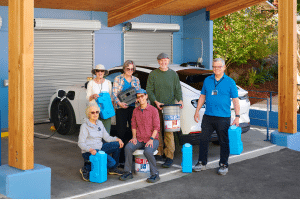
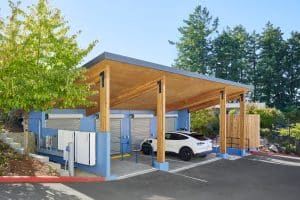 The ROSE Port continuously generates and stores solar energy. In the event of a power outage, the system automatically responds, immediately transitioning into emergency support for the community. When an outage hits, vehicles are relocated, and team and resident volunteers prepare the space. Residents then have access to shelter, device charging and purified drinking water distributed through WaterBricks. The facility’s rainwater collection and purification system holds 3,100 gallons, which Lewis said is enough to provide each resident with a gallon of water per day for approximately eight days.
Lewis said ROSE Port serves a critical purpose for RoseVilla, helping to position it to weather the litany of possible natural disaster-related issues that could await, such as wildfires, ice storms and days-long power outages. He also noted that Oregon is at risk of a major earthquake “that experts say is a matter of when, not if.” Against that backdrop, planning for climate events isn’t just smart business – “it’s required to keep residents safe and supported during a climate crisis,” Lewis said.
Lewis said residents played a central role in shaping the ROSE Port project and the philosophy that served as its foundation. Residents at RoseVilla “drive the vision,” Lewis said, including helping in the development of the resiliency and sustainability action plan through dedicated resident groups. They also participate on an ongoing basis in key initiatives.
In fact, when the ROSE Port system activates, the community’s resident-led “ReadyForce” team is trained for emergency response. Also, more than a hundred residents are members of the community’s Green Team, which works on everything from native planting and sustainability education to collaboration with other communities across the region.
Residents, Lewis said, “aren’t on the sidelines.”
“Residents are eager to share decades of wisdom and experience with us, and that level
of engagement is what makes a project like the ROSE Port possible, and what makes
our community stronger and more prepared,” Lewis said.
The development of the ROSE Port was complex and required integrating new systems, coordinating partners and rethinking how space at RoseVilla is used. A partnership with Green Hammer Design + Build helped the community bridge the gap between vision and execution. Lewis said the biggest challenge for the project was shifting how the community makes decisions.
“When you operate through a resilience and sustainability lens, you’re not looking for the simplest solution,” Lewis said. “You’re looking for one that moves you closer to achieving your goals. Rebuilding the garage would have been the easiest path, but it wasn’t the right decision for RoseVilla and who we’re striving to be.”
For senior living communities interested in exploring a similar project, Lewis advises that they start with their people before diving into the infrastructure itself. A shared sense of purpose helped make decision-making clearer and allowed the project to progress “with real momentum,” he said.
“The ROSE Port worked because it wasn’t just a facilities project. It was a reflection of
values our community already believed in and helped shape,” Lewis said. “My advice is to build that alignment first, because when people are invested in the ‘why,’ anything is possible.”
Lewis believes that sustainability and resiliency present a major opportunity for continuing care retirement communities across the country
“Together, we have the ability and opportunity to drive meaningful change,” Lewis said. “Let’s collectively commit to building responsibly, taking incremental steps to reduce our environmental impact, choosing renewable energy sources and leading by example. The baby boomer generation and beyond expect this from us, and we have the chance to show them that sustainability and resiliency matter.”
Lewis said ROSE Port represents the first of several projects that will help RoseVilla create a more self-sustaining campus.
RoseVilla has moved forward with its second ROSE initiative, a new facility operations center that will house the community’s building operations, grounds and security teams. The facility will include an expanded solar and battery system and rainwater storage of up to 15,000 gallons, which is nearly five times the capacity of the ROSE Port. In addition, Lewis said RoseVilla is exploring the highest sustainability standards achievable for future development initiatives that will expand the community’s campus – keeping its promise to residents to prioritize sustainability and resilience.
“As we build more ROSE projects, our community becomes safer and more resilient, which is what residents expect of RoseVilla and what we expect of ourselves as leaders in the senior living space,” Lewis said.
Lewis said the fire was an unfortunate challenge, but it also helped spur RoseVilla to assess its needs and future with a fresh perspective.
“Losing that garage was disruptive — and a real loss for our residents — but it gave us the
opportunity to start building toward a more resilient, sustainable future for our community,” Lewis said. “I believe sustainability and resiliency is a moral responsibility and a smart business
strategy. More importantly, our residents demand it.”