
 Senior living communities have long contended with the challenges of offering variety in their dining options. One community has embraced that challenge with an ambitious new program that features a major assist with artificial intelligence.
AI-Powered Senior Living Dining Innovation at The Palace Suites in Miami
This year, The Palace Suites, a luxury independent senior living community in Miami, launched “365 in the 305,” a dining program that promises residents a different dinner menu every night of the year, with no repeats. The Palace Suites is part of The Palace Group. Located on The Palace at Kendall campus, The Palace Suites is joined by The Palace Royale, a catered living community; The Palace Renaissance, an assisted living community; and The Palace Nursing & Rehabilitation Center.
“Dining is one of the most talked-about parts of community life, but also one of the most common complaints,” said Haim Dubitzky, principal, vice president of performance excellence and executive director of The Palace Suites. “Menus often get repetitive, and residents crave something new. We wanted to do what hasn’t been done before by bringing a new level of creativity and excitement to the table.”
How “365 in the 305” Works: A Different Dinner Menu Every Night, No Repeats
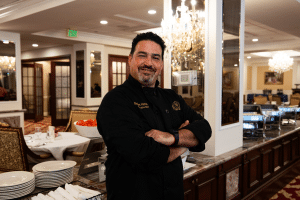
The culinary team at the Palace Suites first used AI to plan the dining offerings for a party. That experience inspired the team, including Executive Chef Richart Hartman, to consider how AI could help not just with individual events but with daily menu planning on an ongoing basis. The team started with 50 unique menus designed to provide “a trip through the 50 states.” The team continued to build on the concept, ultimately creating themed dinners from ports of call and nearly 200 countries.
Traditional favorite dining options such as roast chicken and turkey burgers remain available, but the rotating daily specials, which are intended to reflect flavors from around the world, take the spotlight for residents.
“Every night feels different,” Dubitzky shared. “It’s fun, it’s creative, and when a resident doesn’t care for a dish, we can honestly say, ‘No worries, we won’t serve it again for another year.’”
Resident Dining Satisfaction Results: Variety Complaints Nearly Disappear
Dubitzky said the program has been an obvious hit with residents.
“We’ve received only positive feedback,” Dubitzky said. “Complaints of variety have nearly vanished, and the diversity in dining has been welcomed with open arms.”
In addition to the residents, their families are embracing the program, according to The Palace Suites, with residents’ children complimenting staff on the variety and quality of the meals that their parents are enjoying.
Prospective Residents and Family Perception: Believing the Concept After Experiencing It
Dubitzky said prospective residents do not always comprehend the concept of “365 in 305” before experiencing it.
“Some don’t believe it until they join us and see for themselves,” Dubitzky said. “It’s a bit hard for them to fathom what we’ve accomplished and continue to do daily, but once they join us, they completely understand.”
Staff Impact: Culinary Team Engagement, Learning, and Professional Growth
The program does not just benefit residents. According to Dubitzky, the kitchen staff has been energized by the variety of dishes that they are creating. They are learning and creating new dishes and skills, allowing them to grow as professionals.
AI in Senior Living Menu Planning: Scaling Creativity Across 365 Unique Dinners
AI has played a vital role in building the program.
“Without AI, this would’ve been an incredibly challenging project to bring to fruition,” Dubitzky said. “There just aren’t enough hours in the day, week, or month for a chef to truly have the inventiveness demanded of the recipes and the menu themes for 365 unique days in the year.”

AI Can Spark Ideas—But People Execute: Why Chefs Still Drive Quality

Although AI is critical, Dubitzky emphasized that the program’s ongoing success still depends on the efforts and expertise of the staff who manage and follow through on it every day. Dubitzky described AI’s role as the “Robin” to the program’s “Batman” – Executive Chef Hartman.
“Despite AI’s immense possibilities, if you don’t have an engaged workforce and good people who are motivated to execute such a project, it’ll never work,” he said. “People are still at the heart of what we do.”
AI Limitations and Quality Control: Monitoring Output and Preventing “Hallucinations”
As with many innovations, particularly those involving technology, The Palace Suites’ AI-aided approach to variety in dining has required some adjustments along the way, but Dubitzky said that is an expected part of the process.
“AI is sporadic and gets funky sometimes with recipes, descriptions, and lacks consistency at times, so current usage needs to be refined and monitored with every iteration,” Dubitzky said. “As the classic quip goes, ‘results may vary!’”
Overall, Dubitzky said the planning to execute was “spot-on accurate with AI’s help.”
“The constant work is still checking the output for each recipe to know if it makes sense and isn’t combining something crazy like ketchup and cottage cheese on your ribeye steak for Italian night,” he said. “Surprisingly, AI still hallucinates after longer prompts, so some prompts just need to be reset from time to time.”
Why Senior Living Residents Want Menu Variety: Solving the “Same Meals” Problem
The “365 in the 305” program helps to address an inherent challenge that has long faced senior living communities – and their residents: getting tired of eating the same meals over and over again.
“After a few short weeks of the traditional food cycle of your average senior living community’s menu, they get bored and disenchanted,” Dubitzky said. “They want variety, newness and excitement, especially in an independent living community.”
In that way, Dubitzky said the program is not just a good fit for today’s residents – “it’s been a desire for all residents since the beginning of senior living.”
“Only now in 2025 with AI, do we have the capability to actually execute their dreams – and here we come to make it a reality,” he said.