
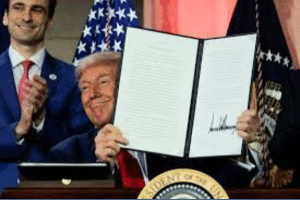
 Last week, President Trump signed an executive order to limit the ability of states to regulate the use of artificial intelligence (AI). The order is intended to ensure American companies are “free to innovate without cumbersome regulation” and to “remove barriers to American AI leadership.” It cites a proliferation of AI legislative proposals in state legislatures, including California and Colorado laws as requiring “complex and burdensome disclosure” due to potential risks posed by AI. The Trump administration is advocating for a “minimally burdensome national standard” in lieu of varied state-level regulations.
The order establishes an “AI Litigation Task Force” within the Department of Justice, tasked with challenging state AI laws on grounds including unconstitutional regulation of commerce and federal preemption. Additionally, the Secretary of Commerce is instructed to evaluate state laws that conflict with the policies set forth in the order, identifying those that mandate changes to truthful AI outputs or compel disclosures potentially in violation of the First Amendment or other constitutional provisions. The Commerce Department is also to suspend remaining funding from the Broadband Equity Access and Deployment Act to any state with conflicting laws.
The Federal Communications Commission is called upon to consider the adoption of a federal reporting and disclosure standard that would supersede conflicting state requirements. The White House Office of Legislative Affairs is also tasked with preparing recommendations for a uniform national framework for AI regulation that would preempt state laws inconsistent with the executive order.