
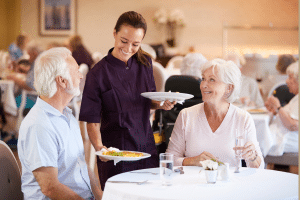
 While a prevalent dining trend in senior living is creating restaurant-like environments, Texas-based Sage Oak has been seeking to create a different atmosphere for residents: eating at home.
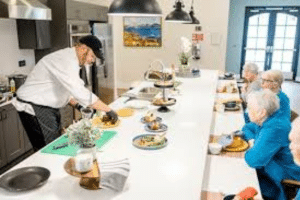
Sage Oak has between eight and 16 beds in its locations. In light of that intimate arrangement, Sage Oak employs an open-kitchen concept in each of those buildings to replicate a home-like feel at meal time, said Loe Hornbuckle, founder and CEO of Sage Oak.
“It’s designed to be like having a private chef cooking three meals for you and your friends at home every day,” Hornbuckle said. “We put the chefs front and center, and the chefs and the clients are together constantly as opposed to very infrequently and communicating only via comment card. It’s a form of interactive dining. We turn meals into more of a social event between the chef and the resident.”
Chef Larry Atwater, who serves as regional dietary director for Sage Oak Senior Living, previously worked in a much larger senior living environment, serving 400 people a day. He felt a disconnect between the chefs and residents – at Sage Oak, “it’s more of a personalized service,” he said.
“We have private chefs in each house, so they interact with the residents on a day-to-day basis, along with their family members,” Atwater said. “I love building those personal connections in the open kitchen.”
Hornbuckle said Sage Oak’s founding motto was “Great care. Great food. Great communication,” and “we believe that a big key to all those things is personalization – and personalization is not just a buzz word.”
Indeed, Atwater said he loves the instant feedback that he receives from residents. If there is something a resident doesn’t like, he’s glad to offer them something different. Sage Oak strives to keep the menu fresh and rotating, while being mindful of the preferences of specific residents. Atwater appreciates the chance to know the people eating his food on a first-name basis and to know their likes and dislikes in detail. “I get to see their faces every day and see what they think of the food,” he said.
As Hornbuckle notes, “If a resident isn’t enjoying the food, you can instantly go, ‘Hey, is there something that’s not to your liking? Is it too hot? Is it too spicy?’ And the dialogue naturally flows from there.”
If a dish does not do well in a certain house, it gets removed from the rotation. The small number of diners and instant feedback allows individual chefs to be nimbler and more responsive, evolving their offerings in real time.
“Every resident has a different palate, and we’re able to cater to their specific palates and their specific dietary needs,” Atwater said. “Every menu at every house is different. We find out what the residents love to eat and what the chefs love to cook and we find the magic in the middle.”
Hornbuckle said the open kitchen also allows the residents to get a rich, sensory atmosphere of cooking that enriches the dining experience – the aromas, the sounds of knives on cutting boards and pans sizzling, and the changing temperature in the room. Some chefs – including Atwater, Hornbuckle wryly implies – like to sing while they’re cooking, too.
“It engages all of the senses, and you’re seeing the chef move around working and you become curious and excited about what’s being cooked,” Hornbuckle said. “And it makes them feel like they’re part of the experience.”
Atwater said the meals are the highlights of the day for many residents, and he’s glad to get to share that excitement in a tangible way rather than being removed from it. He sees the residents come out of their rooms and hears them comment on the aroma of the food, sparking conversation and revving up their appetites.
“You can see it in their faces. You can see it in their smiles,” Atwater said.
An important component of making the Sage Oak model work is training new chefs to interact with residents on a daily basis while they are cooking – they cannot simply cook in isolation.
“Once they get the hang of it, though, they do find it really rewarding,” Atwater said.
Hornbuckle said Sage Oak does not want to hire chefs who are too sensitive to feedback. He said the chefs that thrive at Sage Oak enjoy cooking in the spotlight.
“Cooking is hard. Cooking in front of people with dementia is harder,” Hornbuckle said. “Cooking in front of people with dementia with their family present, who are spending large amounts of money to make sure their loved one has a good experience, is even harder. I think our environment lends itself to accountability. And that’s a really good thing.”
Among the advantages of Sage Oak’s intimate approach is that the chef can become a more active contributor to the caregiving team by engaging with residents and learning about their experiences in the community and sharing that with their colleagues.
Hornbuckle said the personalized approach is not just designed to help residents but to make for a more rewarding experience for the chefs themselves. He believes that is why the dietary team at Sage Oak has been stable under the model.
“Imagine that you’re a chef, and you dedicate your life to preparing meals and helping others who can’t at this stage help themselves as much as they once did,” Hornbuckle said. “Now imagine that you never get to see the clients.”
Atwater said chefs at Sage Oak are glad for the chance to get better and make sure they are doing their best to make for the best possible dining experience.
“As chefs, we’re constantly growing and trying to improve ourselves,” Atwater said. “Being able to have that immediate feedback is a gift. Sometimes, we might change their plate on the fly to get them something they like better. We know how important meals are to them, and we want to get it right. It’s great to have the ability to do that.”