
 Technology is reshaping nearly every facet of the senior living experience—from how we engage with residents and families to how we manage operations, staffing, and care delivery. Yet the journey to widespread technology adoption is complex, layered, and full of both promising breakthroughs and persistent barriers.
To better understand this evolving landscape, Argentum conducted a comprehensive survey of senior living leaders, including C-suite executives and top technology officers. The result is the 2025 Argentum Technology Report: The State of Technology Adoption in Senior Living—a data-rich resource, sponsored by A Place for Mom, that reveals where we stand, what barriers remain, and what opportunities lie ahead.
This member-exclusive report, valued at $199 and available free to Argentum members, provides more than data—it offers a strategic lens through which senior living professionals can assess their technology priorities, benchmark against peers, and plan for the future.
“This report is a powerful reflection of where the industry is headed,” said James Balda, President and CEO of Argentum. “The insights from senior living leaders make it clear—technology is no longer optional. It’s fundamental to providing quality care, driving efficiency, and meeting the expectations of today’s and tomorrow’s residents.”
Solving the Puzzle of Interoperability
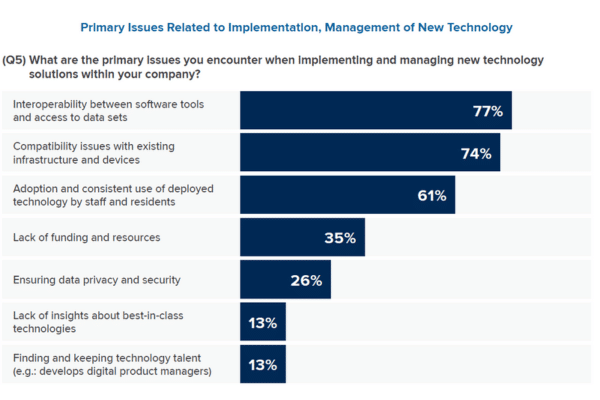 One of the most persistent challenges revealed by the report is the issue of interoperability. While technology options have grown exponentially, the systems themselves often do not communicate effectively with each other—or with existing infrastructure. More than 77% of executives surveyed ranked interoperability as a top-three barrier to successful technology implementation.
Operators are often caught in the middle of competing vendor platforms, each offering solutions that may work well in isolation but fall short when it comes to integrating data across the full resident experience. The result? Information silos that hinder care coordination, delay innovation, and burden staff with duplicate efforts.
This lack of interoperability doesn’t just create headaches—it threatens the scalability and sustainability of senior living’s digital transformation. For true progress to occur, the industry must work toward common standards, shared taxonomies, and more open collaboration between technology partners and providers.
The Funding Gap: Innovation with Limited Resources
While many leaders are eager to invest in new technologies, the financial realities of operating a senior living community remain a significant hurdle. Nearly two in three survey respondents (63%) identified limited funding and resources as a major barrier to adoption.
Even when asked to imagine receiving a $2 million technology grant, most leaders described using the funds to establish core infrastructure—such as electronic health records, upgraded Wi-Fi, staff training platforms, or resident monitoring systems. These are foundational investments, not futuristic experiments.
This underscores the difficult balancing act facing many providers. Innovation is a necessity—but without sustainable funding models, many are forced to choose between today’s operational needs and tomorrow’s strategic gains. As one respondent put it, “We need to shore up the basics before we can even begin to dream bigger.”
Artificial Intelligence: From Buzzword to Business Driver
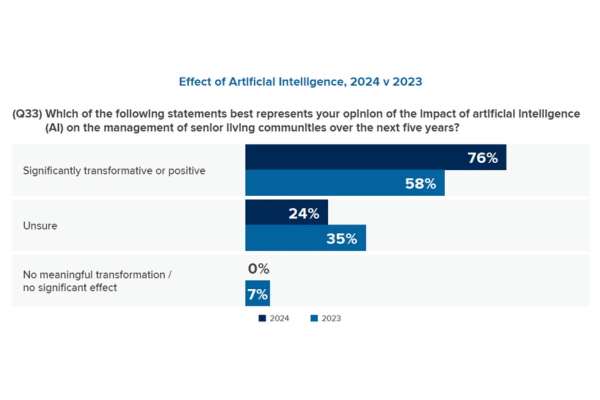 The 2025 report makes one thing clear: AI has arrived in senior living—and it’s gaining ground quickly. A full 76% of leaders surveyed believe that artificial intelligence will have a transformative or positive effect on the industry within the next five years.
Already, AI is being implemented in a wide range of applications. Predictive analytics are helping inform staffing decisions and care planning. Chatbots are being used to enhance resident engagement and streamline customer service. AI-powered content tools are assisting marketing teams. Even robotics are making a modest entrance, particularly in housekeeping and mobility support.
Importantly, this enthusiasm for AI is paired with cautious optimism. While leaders are embracing AI’s potential, most also acknowledge that its effect on resident care has been limited so far. Nearly one-third of respondents said the impact has been “minor,” and an equal number reported seeing no significant change—yet.
Still, the momentum is undeniable. In survey comments, leaders shared plans to deepen their AI investments in the coming years—from automating care documentation to analyzing clinical notes, to deploying ambient monitoring for safety and quality of life. The appetite for smarter systems is growing, and so is the recognition that AI can be a powerful ally when implemented with intention.
“We are excited to see AI adoption and optimism growing in our industry—among Operators, but also among caregivers,” said Suzy Julius, Chief Product and Technology Officer at A Place for Mom. “We are proud to support the industry in this transformation. We will continue to evolve to help Operators unlock insights about caregivers and seniors, improve efficiency, grow occupancy, and focus on what matters most to us all—caring for seniors and families.”
Data without Direction: The Need for Standardization
While many senior living providers are collecting valuable data, the challenge lies in making that data actionable. The report found that fewer than 26% of organizations are fully aligned internally on how to define and measure resident health and wellness outcomes.
This lack of standardization complicates efforts to benchmark progress, participate in value-based care models, and even communicate success to families, partners, and regulators. In short, we’re gathering the numbers—but we aren’t always speaking the same language.
Encouragingly, about one-third of leaders say they are actively working to align around common definitions and frameworks. Still, the report makes it clear that for data to truly drive decisions, there must be agreement—not only within organizations but across the industry.
A Call for Collaboration: Co-Innovation as the Path Forward
Perhaps the most inspiring insight from the report is the clear desire for partnership. An overwhelming 84% of respondents expressed a willingness to co-innovate with technology vendors—through pilot programs, product development, or shared feedback loops.
This shift toward collaboration reflects a broader understanding that no one can solve these challenges alone. Operators bring deep knowledge of day-to-day realities. Vendors bring technical expertise and tools. Associations like Argentum can help bridge the gap, serving as a neutral convener to vet solutions, benchmark ROI, and elevate best practices.
Survey participants were explicit in their desire for such leadership. Many called on Argentum to establish common technology standards, facilitate multi-operator pilot programs, and create shared dashboards that could serve as industry benchmarks. The message was clear: The path forward must be paved together.
Barriers Worth Breaking: Six Challenges to Overcome
Beyond the key themes of interoperability, funding, AI, data alignment, and collaboration, the report also identifies six broader systemic challenges that must be addressed:
- Silos that prevent technology platforms from working together
- Vendor disconnects that result in tools not tailored to senior living
- Slow value-based care readiness due to poor data infrastructure
- Lack of third-party vetting to determine which solutions are worth investing in
- Rising consumer expectations for smart, tech-enabled services
- The urgent need for high-quality, standardized data
Each of these challenges touches multiple layers of the senior living ecosystem—strategy, staffing, operations, and resident engagement. And each presents an opportunity for innovation, leadership, and alignment.
A Member Resource with Real Value
The 2025 Argentum Technology Report doesn’t just surface problems—it offers insights, inspiration, and pathways forward. As a member-exclusive benefit, the report is available at no cost to Argentum members and represents a $199 value.
More importantly, it represents a commitment to empowering leaders with the tools and knowledge they need to drive change. Whether you’re a CEO looking to shape long-term strategy, a CIO vetting new platforms, or a regional operator making decisions on the ground, this report provides the clarity and context you need.
Argentum members can download their complimentary copy today. For nonmembers, this is a powerful reminder of the value of membership—and the depth of insight Argentum delivers year-round.
With Gratitude to Our Sponsor
Argentum extends sincere thanks to A Place for Mom for their generous sponsorship of this important initiative. Their partnership made this report possible and reflects a shared commitment to advancing technology and improving quality of life for older adults and their families.
The Future Is Now
As the senior living industry continues to meet the demands of a changing population, the role of technology will only become more essential. The 2025 Argentum Technology Report offers a clear-eyed view of where we are today—and a compelling vision of what’s possible tomorrow.
Innovation is not a luxury. It’s a responsibility. And with the right tools, partnerships, and leadership, the senior living industry is well on its way to embracing that future.