
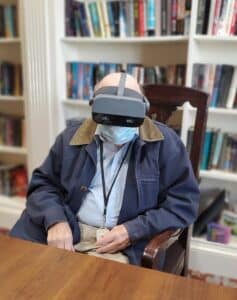
NORWOOD, Mass.—Residents of LCB Senior Living communities are helping the neuroscientist who discovered the first Alzheimer’s gene to pilot technology that evaluates the brain’s micro-changes over time. The initiative by LCB and REACT Neuro seeks to transform brain wellness by making digital cognitive checks a standard tool in health care, just as blood pressure readings, cholesterol testing, and other customary monitoring already enable people to take proactive steps to address their physical wellbeing.
Every week, 150 LCB assisted living and memory care residents don a specialized headset equipped with interior cameras and a microphone. Working in conjunction with an iPad application, the device digitally administers selected cognitive tests, such as Trailmaking, Stroop, and category fluency, that until now have been generally conducted with pencil and paper.
At the conclusion of the process, which takes about five minutes, the participants receive a report on their individual results. LCB is also aggregating the information with the goal of setting benchmarks for tailoring programming and services. The first data should be assembled in early 2021.
The device is being developed by Cambridge, Mass.-based REACT Neuro, co-founded by two neuroscientists and a neurosurgeon at Harvard Medical School and Massachusetts General Hospital. One of the co-founders is Dr. Rudolph Tanzi, who identified the first Alzheimer’s gene. He is the Joseph P. and Rose F. Kennedy professor of neurology at Harvard Medical School and vice-chair of neurology and co-director of the McCance Center for Brain Health at Massachusetts General Hospital.
Tanzi has published over 600 research papers, co-authored three best-selling books with Deepak Chopra, was named a “Rock Star of Science” by GQ Magazine and was included on the Time Magazine list of 100 Most Influential People in the World. In his spare time, he plays keyboards for Joe Perry and Aerosmith.
Tanzi, who provides brain health consultation to the New England Patriots, had the concept for REACT Neuro after head coach Bill Belichick asked him if there was a better way to diagnose concussions and decide when a player could safely return to the playing field. In pursuing the idea, Tanzi and his colleagues realized the technology for addressing these questions could have broader implications for assessing overall brain health.
“For age-related diseases below the brain, such as heart disease, we detect problems early so we can try to stop them before symptoms appear,” said Tanzi. “However, we only diagnose diseases such as Alzheimer’s and Parkinson’s when the brain has gone downhill to the point the conditions become symptomatic. We need to nip these diseases in the bud, well before symptoms start showing.”
LCB and REACT Neuro began working together in 2019 to refine the technology’s concept and application. This fall, LCB residents in Massachusetts and Connecticut began using REACT’s latest iteration installed in the Pico Neo 2 Eye VR headset, continuing to refine the product. LCB plans to eventually expand the program throughout its 27-community portfolio.
“In working with REACT Neuro, we are developing programs to provide residents with the most sophisticated cognitive health technology,” said LCB CEO Michael A. Stoller. “Furthermore, through this initiative our residents are helping transform the future of brain wellness, a mission that is gratifying and exciting for everyone in our organization.”
Neuroscientist Shaun Patel, who co-founded REACT Neuro and serves on the faculties of Harvard Medical School and Massachusetts General Hospital, said: “Today we all understand cholesterol and blood pressure measurements mean something and can be informative to heart health. There hasn’t been anything like that for the brain, but our partnership with LCB Senior Living will turn the vision into reality.”
About LCB Senior Living
Founded in 2011, Norwood, Massachusetts-based LCB Senior Living operates 27 communities throughout the Northeast. Its website is LCBseniorliving.com.