
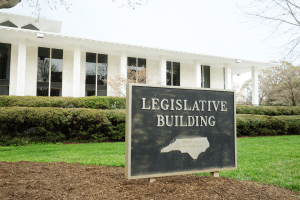
 North Carolina senior living advocates are applauding new legislation that they believe will create a more reasonable regulatory environment in the state.
The North Carolina General Assembly overrode the veto of Gov. Josh Stein on July 31 to pass the REINS Act, which aims to limit the regulatory powers of state agencies. In particular, the legislation requires that regulations that create an economic cost meeting certain thresholds must pass a level of legislative review, depending on that estimated cost.
The tiered thresholds mean that any proposed permanent rule with an economic cost of $20 million or more over five years must receive direct approval from the General Assembly. Rules that would cost more than $10 million over five years would need unanimous approval by the rulemaking board or commission. Rules exceeding $1 million over five years would require a two-thirds supermajority vote from the adopting body. Exceptions are made for rules mandated by federal law.
Frances Messer, CEO of the North Carolina Assisted Living Association, said she believes the REINS Act will help regulatory agencies in the state think through rules more carefully, giving them reason to pause and consider the financial ramifications on businesses and other organizations.
“I think it’s going to help them to step back, use common sense, and think these things through better,” she said.
Chris Parker, president of Vienna Village, a family-owned and operated assisted living facility in Forsyth County, North Carolina that is celebrating its 60th year in operation, said too often the existing process did not include a consideration of the cost involved with a new or existing regulation. For example, the Division of Health Service Regulation introduced a new requirement increasing the dairy serving requirement for adult and family care homes from two to three servings a day. Parker and others in the state’s senior living industry argued that the cost of the requirement on the industry needed to be studied and weighed in the decision, but he said the agency said that it would be a “de minimis” cost – a legal term meaning that any costs would be minimal in nature. Despite objections from the industry that the costs would be significant, the rule was passed by the agency.
Parker said the new legislation’s requirement that regulatory changes with notable economic costs go through the legislative process promises to bring closer scrutiny to the necessity of new rules and their possible costs for those being regulated.
North Carolina Rep. Jeff Zenger is one of the bill’s sponsors, and his district includes Vienna Village. He worked with Parker and Messer, hearing their concerns about the regulatory process and its impact on the senior living industry. As the owner of a construction business, Zenger also approached the issue as someone who believed the building industry was facing regulations that were undermining housing affordability and growth.
“It’s a very big, monumental bill to get across the threshold,” Zenger said.
Zenger said the previous regulatory rules put the process of sunsetting old regulations or stopping new ones “on the backs of citizens.” Citizens would have to meet certain thresholds to challenge regulations and then demonstrate why they were unnecessary or too costly. The new legislation “flips it,” he said. “The whole idea was to turn this around.”
“It’s not up to us as the general public to prove that a regulation is not worthy and try to get them from ‘on high’ to go ahead and sunset it,” Zenger said. “It is on them to prove to us that it is worthy.”
Approximately 10 years ago, Parker said the state began to bring industry representation into the review process of state agency rules. The hope, Parker said, was that the review process would help to identify unnecessary rules that could be sunset. Parker and Messer participated in the process, but they were dissatisfied with the results.
“What Frances and I learned over that 10-year period is that it’s very hard for the agencies to sunset anything,” Parker said. “In fact, what happens is they usually want to create more on top of what’s there, because in their mind, more rules are better.”
Parker and Messer said they strongly believe that North Carolina is one of the most heavily regulated states in the country for assisted living, based in part on conversations with operators who operate in other states.
“We’re very fortunate to be a partner with Argentum so we have national comparisons,” Messer said. “There are statistics and articles that show that North Carolina is very heavily regulated and is considered one of the very most heavily regulated states when speaking of assisted living rules, family care homes and small group homes.”
Messer said the broader implications and impacts of the regulatory environment – beyond those rules specific to senior living – are important to consider, too. For instance, the assisted living industry depends heavily on affordable construction, and she said regulations affecting new construction and retrofitting old buildings “is a huge deterrent to business and industry coming into North Carolina.”
In pointing to recent regulatory challenges, Messer pointed to dramatically expanded standards for emergency plans developed in the aftermath of Hurricane Helene. She said the standards included useful best practices but also added costs and demands on operators that were not necessary. In one case, for example, a unique instance of an evacuation that did not go well was used as the basis for rulemaking to be applied broadly, despite the rarity of the circumstances of the incident.
Zenger said state regulations had grown too reactive and turned unusual events into the foundation for new rules.
“We’re at a point right now where they pick these one-off things. Building code is a great example,” Zenger said. “Something really obscure happens. It’s a one-in-a-100 million chance that it’s ever going to happen again, but ‘hey, we gotta have a rule.’”
Zenger said the economic threshold figures were set in part to avoid involving the General Assembly in regulations that did not need their attention.
“There are so many rules that if we’ve set the number too low, that it’s so bogged down, then the General Assembly would have to become a full-time General Assembly so that we can vote on rules every day,” Zenger said. “We don’t want the General Assembly to have to be involved all the time, but we also wanted to create a higher bar for rules to be enacted or to stay active.”
Zenger said he hopes the new legislation will first lead to a slowdown in rulemaking at the agency level and then prompt the sunsetting of some existing regulations. He emphasized that the new process keeps open a path for “worthy” regulations to pass.
“There may be a rule that comes down the road that comes to the General Assembly that costs $50 million over five years, but it may be a worthy rule,” Zenger said. “The idea that the General Assembly would just always vote things down is not true.”
Messer noted that collaboration with state agencies will remain critical and that North Carolina senior living providers have “a wonderful relationship” with the Division of Health Services Regulation and the health care licensure section.
“We’ve been very fortunate that in the past 10 years we’ve been more invited in and we’re able to participate in conversations with the advocates, with the agency and with our own providers,” Messer said.
Those collaborations often have been fruitful, leading to refinements based on industry feedback, she said.
“We’re grateful for that collaboration, and we hope to see more of it going forward.”