
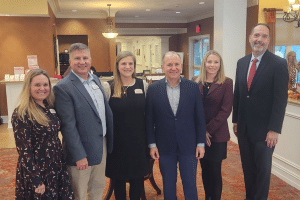
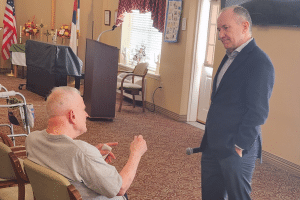
 U.S. Representative Lloyd Smucker’s (R-PA) Essential Workers for Economic Advancement Act (H.R. 5494) took center stage at the Pennsylvania Assisted Living Association (PALA) meeting on Monday, November 24, where Argentum President and CEO James Balda joined providers to discuss federal workforce solutions for senior living communities.
H.R. 5494 is bipartisan legislation aimed at easing critical workforce shortages through the creation of a new H-2C nonimmigrant visa program. The visa would be available to employers who can demonstrate that positions have gone unfilled for three consecutive months in areas where unemployment is 7.9% or less. The program is designed as a temporary, market-driven tool that can adjust to economic conditions and support essential industries, such as health care and long-term care, that are struggling to find enough workers.
The bill has drawn broad bipartisan support, including from Reps. Henry Cuellar (D-TX), Tom Suozzi (D-NY), Maria Elvira Salazar (R-FL), Juan Ciscomani (R-AZ), Mike Kelly (R-PA), Mark Amodei (R-NV), Andy Harris (R-MD), Don Davis (D-NC), Rich McCormick (R-GA), and Mike Kennedy (R-UT). Nationally, the Essential Worker Immigration Coalition (EWIC) has endorsed the legislation, noting that it would establish a market-based pilot program with a flexible annual cap of up to 85,000 positions, strong employer accountability, worker portability, and rigorous compliance tools to ensure visas are used only where proven workforce shortages exist.
 In Pennsylvania, the stakes are especially high. Assisted living and other senior living communities in the state currently serve more than 127,000 seniors across 1,045 residential communities and employ more than 44,000 caregivers and other staff. By 2040, these communities will need more than 205,000 additional workers to meet the needs of an aging population, and industry that already contributes an estimated $6.2 billion in economic impact to the Commonwealth.
Assisted living is also one of the most cost-effective long-term care options. In Pennsylvania, the average monthly cost of assisted living is approximately $4,500, compared with about $9,034 for nursing home care and nearly $19,656 for 24/7 home health aide support. These savings matter not only to residents and families, but also to state and federal programs: assisted living is estimated to save Medicaid billions of dollars annually nationwide by offering a more efficient care setting.
Against this backdrop, Balda joined PALA members to underscore how policies like the Essential Workers for Economic Advancement Act can help stabilize and grow the workforce that supports seniors in assisted living communities. Argentum has emphasized that the long-term care industry must recruit and retain more than 20 million workers by 2040, when demand for care is expected to peak.
 “Argentum appreciates efforts to address critical workforce challenges across the country, including through the Essential Workers for Economic Advancement Act,” the association has noted in its advocacy. The organization continues to call on policymakers to advance a full slate of solutions, ranging from domestic workforce development to thoughtfully designed visa programs, that specifically support the long-term care sector and the many roles required to make a senior living community feel like home, from direct caregivers to dining, housekeeping, and hospitality professionals.
At the PALA meeting, Balda reaffirmed Argentum’s commitment to working alongside Pennsylvania providers, state partners, and the Commonwealth’s congressional delegation to ensure that federal policy keeps pace with the growing needs of older adults, and that senior living communities have access to the workforce they need to provide high-quality, person-centered care.