
Tarkett, a global leader in innovative and sustainable flooring solutions, hosted its third annual Insights + Innovation Retreat last month, bringing together diverse and complementary perspectives from architects, interior designers, owners and operators of senior living communities. Centered on the theme “The Science of Belonging,” the event, co-sponsored by furniture manufacturer Kwalu, explored how design can help foster community engagement across the continuum of care. Participants examined the relationship between the built environment and cognition, behavior, mobility, visual comfort, and social engagement, while considering how design intent translates into the everyday experiences of residents, families, and staff.
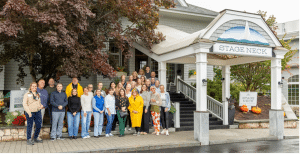 “As senior living continues to evolve, we have an opportunity to think differently about what the built environment is being asked to do,” said Sandra Soraci, director of healthcare & senior living strategies for Tarkett Commercial. “Safety and function will always be essential, but they are only the beginning. We want to better understand how design can also support confidence, identity, dignity, comfort, and meaningful human connection.”
The retreat was structured to move participants from framing opportunities to applying insights. Interactive discussions, peer-to-peer breakouts, resident-experience exercises, and design workshops explored topics including:
- Designing for cognitive wellness and behavioral ease
- Moving from environments that are simply safe to spaces that feel supportive and confidence-building
- Comfort as a strategic design consideration
- The role of identity, familiarity, and choice in creating belonging
- How environments can encourage social connection without forcing participation
- Design practices the industry may need to stop, start or reconsider
- The relationship between design intent and operational reality
Several priorities emerged from the group’s activities and discussions, including:
- Broaden our understanding of safety to consider aspects of emotional well-being.
Of course, physical safety is necessary but should be viewed as a baseline requirement rather than a project objective. To support overall wellness more holistically, project outcomes should be measured by their ability to encourage a sense of belonging and community engagement—while maintaining safety across the continuum of care.
- Design with an understanding of sensory and cognitive limitations.
Community engagement relies on residents feeling confident, independent and autonomous. Surface glare, uneven flooring transitions and overwhelming signage are just a few examples of how design decisions can unintentionally lower confidence and cause residents to be withdrawn and isolated.
- Create spaces that draw both residents and the broader community.
Participants favored approachability over mere accessibility, creating spaces that draw people in rather than shut them out. Ideas included spaces where participation can happen naturally, seating that works for both front-row participants and those who prefer the edges, and dining rooms used beyond mealtimes. The group also discussed public spaces, such as cafés, wellness hubs and outdoor dining areas that would bring in families and neighbors.
- Support care staff with passive technology.
Staff continuity and organizational culture drive resident safety, while time constraints on caregivers can limit residents’ sense of independence. Ambient, non-camera technology was discussed as a way to provide caregivers with insight when they’re not in the room, without sacrificing resident safety or relying on intrusive surveillance.
“The real opportunity is to stop thinking of belonging as something that happens after a community is designed,” Soraci said. “Belonging can be an outcome we intentionally design for from the beginning.”
To learn more about Tarkett research and flooring solutions for senior living communities, visit https://commercial.tarkett.com/senior-living-flooring.
About Tarkett
With a history of more than 140 years, Tarkett is a worldwide leader in innovative and sustainable flooring and sports surface solutions, generating net sales of 3.3 billion euros in 2025. The Group has close to 12,000 employees, 25 R&D centers, 11 recycling centers and 33 production sites. Tarkett creates and manufactures solutions for hospitals, schools, housing, hotels, offices, stores and sports fields, serving customers in over 100 countries. To build “The Way to Better Floors,” the Group is committed to circular economy and sustainability, in line with its Tarkett Human‐Conscious Design® approach. https://url.avanan.click/v2/r01/___www.tarkett-group.com___.YXAzOmFyZ2VudHVtOmE6bzozMDUyNDE2MmQ0NmQxNzhmOTJhMDJmMjQ4MDQ0MmI1Yzo3Ojg5ZTg6MjUwNTY1ZjFiMWYwZjg0MmM5YWIxMTMzMmFkMTRmNTg0MmFmNGNhMmE0NTYwYWExZDk0MGQ5ZmQ5YmI4ZDg5YTp0OlQ6Rg
Every Step Matters
For years, Tarkett has raised the sustainability standards of the flooring industry. The company designs floors with transparency you can trust as it creates healthy impacts on indoor spaces and protects our air, water, soil, and every living thing. Tarkett’s ReStart® take-back and recycling program will either repurpose or recycle every type of flooring from any manufacturer. Its near-term science-based carbon emissions reduction targets have been validated by the Science Based Targets initiative (SBTi) and are fully aligned with the Paris Climate Agreement objective to limit global warming by 1.5 degrees Celsius. For more information, visit commercial.tarkett.com/sustainability.
###
Media Contact: Courtney Bolin | [email protected] | 317-873-8100 ext. 282