
NIC MAP’s updated market outlook shows demand accelerating as construction slows, creating an urgent capacity challenge and a generational investment opportunity.
 Two years ago, NIC MAP quantified a widening gap between the senior housing available in the United States and the demand expected from a rapidly aging population. Its newly updated Senior Housing Market Outlook makes clear that the industry has not closed that gap. It has grown.
The timing is especially consequential. The first baby boomers are turning 80, beginning the steepest period of growth in the nation’s 80-plus population on record. At the same time, senior housing communities are filling, construction starts are near historic lows and a large share of the nation’s existing inventory is aging.
“The demographic wave is no longer something on the horizon. It is here,” said Arick Morton, CEO of NIC MAP.
The report’s central message is not simply that more older adults will need housing and services someday. Demand is already translating into move-ins, while the development decisions being made, or deferred, today will determine how much capacity is available later this decade.
Demand Is Already Showing Up
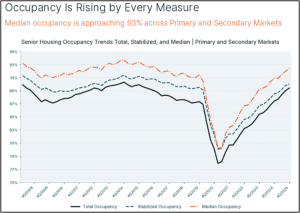 According to the second edition of NIC MAP’s Senior Housing Market Outlook, stabilized occupancy has surpassed 90%, median occupancy is approaching 93% across primary and secondary markets, and total occupancy, including communities still in lease-up, is on pace to cross 90% by the end of 2026.
Absorption offers an even clearer picture of demand. Over the past four years, approximately 32,000 additional senior housing units have been occupied annually. That is roughly 50% higher than the previous annual record of fewer than 22,000 units.
“Demographics on paper are increasingly becoming move-ins on the ground,” Morton said.
That distinction matters. Demographic projections can help the industry anticipate future demand, but absorption measures actual decisions by older adults and families. Four consecutive years of record-level absorption demonstrate that the shift is not confined to a single quarter or a small number of markets. It is a sustained change in the number of households choosing senior housing.
The demographic curve is also unusually predictable. The U.S. population age 80 and older is projected to grow by approximately one-third by 2030 and nearly double by 2040, adding about 5 million people within five years and 13 million within 15 years. Those projections are grounded largely in the number of people already alive and moving toward their 80s, making the direction of demand far less speculative than many long-range market forecasts.
Construction Is Moving in the Opposite Direction
 While demand has strengthened, senior housing construction starts have fallen approximately 67% since 2021. More than 30,000 units broke ground that year. In 2025, starts totaled roughly 10,000. The decline reflects familiar pressures: elevated interest rates, higher construction costs, persistent labor constraints and operating margins that, while improving, have not fully returned to pre-pandemic levels.
The consequences will not be easily or quickly reversed. A senior housing community typically takes approximately two years to move from construction start to opening. That means the thin pipeline already limits the amount of new inventory that can reach the market through at least 2027. Even if development activity accelerated immediately, it would take time for new supply to become available.
At today’s development pace, NIC MAP estimates the cumulative need for additional senior housing will reach approximately 576,000 units by 2030 and exceed 1 million units by 2035. The annual need rises above 140,000 units in 2027 and remains near 100,000 units during much of the following decade. By comparison, the strongest single year of inventory growth this century delivered slightly more than 56,000 units.
In other words, returning to the industry’s historical peak would still leave supply well below what is needed during the steepest years of demographic growth.
Existing Communities Are Part of the Capacity Strategy
Closing the gap cannot depend on ground-up construction alone. More than 40% of existing senior housing units are over 25 years old, while communities open for less than two years have fallen from 8% of the nation’s inventory in 2020 to just 3% today. That makes renovation, repositioning, campus expansion and adaptive reuse essential parts of the capacity conversation.
Older properties may require substantial investment in building systems, unit configurations and common areas. They must also compete against the residential expectations today’s consumers bring with them, including greater privacy, more natural light, in-unit bathrooms, flexible spaces and reliable technology.
For operators, reinvestment is therefore about more than appearance. It can determine whether an existing community remains competitive, whether underused space can become productive capacity and whether a building designed for an earlier generation can meet the needs and expectations of the next one.
This creates a particularly important strategic window. With new supply constrained, well-located communities that modernize their physical plant, strengthen operations and prepare for higher demand may be positioned to capture growth before the broader development pipeline recovers.
A Trillion-Dollar Need, and Opportunity
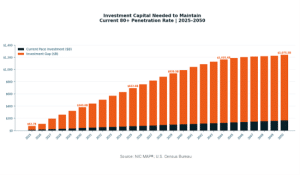 NIC MAP estimates that maintaining today’s level of senior housing availability for the country’s aging population will require more than $1 trillion in cumulative investment through 2050. That figure encompasses more than new buildings. It points to the need for multiple forms of capital supporting new development, expansions, renovations, conversions and repositioning of existing properties. It will also require greater coordination among operators, developers, lenders, institutional investors, healthcare partners and public-sector leaders.
Capital markets are already responding to senior housing’s strengthening fundamentals. According to the report, senior housing delivered a 10.6% one-year total return in the NCREIF Property Index for 2025, compared with 4.9% for the broader index, making it the top-performing major commercial real estate property type. Senior housing transaction volume also exceeded $15 billion in 2025, an industry high.
Those results reinforce the investment case, but strong national fundamentals do not eliminate the need for disciplined local analysis. Senior housing remains a highly localized business. Occupancy, competition, pricing, workforce availability and construction pipelines can differ significantly from one market to the next. A community ultimately succeeds within its own trade area, not within a national average.
The opportunity, therefore, is not simply to build more. It is to understand where capacity is most constrained, which products and price points a market can support, how existing communities can be improved and whether the local workforce can staff additional units.
The Window for Action Is Narrowing
For operators, the updated outlook creates an immediate planning mandate. Portfolio reviews should identify communities with expansion potential, assets at risk of functional obsolescence and markets where rising occupancy may support reinvestment. Capital plans should account for a consumer with different expectations, while workforce strategies must grow alongside physical capacity.
For developers and capital providers, the report underscores the value of building the partnerships, land positions and financing structures needed to move when projects become feasible. For policymakers and local leaders, it points to the importance of approvals, zoning, infrastructure and public-private approaches that can help new housing reach older adults more quickly.
The senior housing supply gap is no longer a distant projection. The demographic growth is beginning, communities are filling and the construction pipeline cannot respond overnight. The industry’s challenge is to convert that certainty into action, by investing in the communities operating today while building the capacity older adults and families will need tomorrow.
The full NIC MAP Senior Housing Market Outlook, Second Edition is available online.