
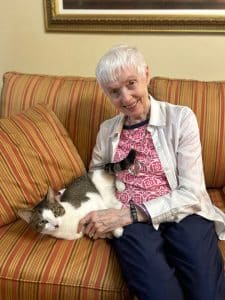
 Waltonwood Senior Living’s second annual Seniors Helping Seniors campaign provided invaluable support for local animal shelters while also offering residents a uniquely rewarding way to give back to their local communities.
The campaign, which is part of NBC’s Clear the Shelters program, spanned all 12 of Waltonwood’s communities in Michigan, North Carolina and Virginia. During the three-month program, Waltonwood residents collected 3,000-plus items for local shelters, including 153 fleece blankets, 423 dog toys, 1,055 pounds of dog food, 290 pounds of cat food and nearly 400 cans of wet food.
“We’re very fortunate that we’re surrounded by people that love to do good for the local community,” said Sara Bailey, senior regional director of sales & marketing for Waltonwood. “It’s given our residents so much joy and purpose.”
Waltonwood also is covering adoption fees and costs for all of its residents who adopt pets through the program. Waltonwood noted in a press release that the National Institutes of Health has reported that 36% of older adults who own pets report fewer feelings of loneliness, lower levels of stress and higher physical activity compared to those without animal companionship.
“Pairing seniors with senior pets is a natural fit,” Bailey said. “Both are too often overlooked. When they come together, it changes two lives — not just one.”
Laurel Sass is a resident of the Waltonwood community in Charlotte, North Carolina. She formerly worked at an animal shelter in Myrtle Beach, and she was thrilled to return to helping animals in a similar way with the Seniors Helping Seniors program. She even adopted a cat, Lucky Lad, when the cat warmly approached her while she was visiting the cat room of the Humane Society of Charlotte. Sass said she finds immense joy through Lucky, who now roams her apartment, perches on her washing machine and greets neighbors during her “office hours.”
“When you wake up in the morning, and there’s a face looking down at you with a toy that he’s just dumped in your bed for you to play with, it’s a great feeling,” Sass said.
As an animal lover, Sass said she appreciates that Waltonwood’s communities are pet friendly. Waltonwood’s pet-friendly amenities include “Bark Parks,” walk-out apartments and spacious courtyards.
Sass noted that Lucky quickly has developed into a “community cat” beloved by residents and staff. Sass has a sign on her door saying, “Hi, my name is Lucky. Please keep the door closed so I don’t get out, but I would love to meet you.”
“I tell anybody if you’re depressed and weary and need someone to talk to, come see us,” Sass said. “Lucky runs to the door, greets everybody, performs his tricks – he does do tricks – and he’s like family. It brings everybody together. He makes everyone feel welcome. I’ve said that people don’t come to visit me. They come to visit Lucky. And I’m fine with that.”
Eileen Bouressa of the Humane Society of Charlotte, one of the local animal organizations to partner with a Waltonwood community, said, “We are so fortunate to be the recipient of all this love from Waltonwood.”
“A lot of times our senior animals tend to take the longest to be adopted,” she said. “And the longer an animal is at the shelter, the harder it is on their immunity, and it’s stressful for them. The first choice for a lot of people is they want an entire lifetime with their pets. So unfortunately, the seniors tend to sit behind.”
Consequently, the partnership with Waltonwood is “a perfect combination,” helping to house senior pets “so much faster” than they would otherwise, she said.
“Seniors oftentimes are looking for someone who doesn’t need to be running a marathon with them,” Bouressa said. “They’re looking for that quiet companion.”
Bouressa said the Humane Society of Charlotte partners with different senior living communities, but Waltonwood’s commitment to the program is remarkable. Not only do Waltonwood residents frequently visit with animals in the shelter environment, providing critical socialization for them, but she said Waltonwood has provided vital supplies that allow the Humane Society to spend its dollars on other important expenses. Waltonwood also has helped to spread the word about the shelters’ efforts and needs to the larger community.
“Those dollars are going into our program and helping us to save more animals,” Bouressa said. “With everything they have done, they have impacted hundreds of animal lives.”
Bailey said the residents love working with Humane Society representatives.
“They’re such great people, and the way that they take care of the animals that they have and the way that they partner with us, our residents are so grateful to be a part of it,” she said. “It’s been incredible.”
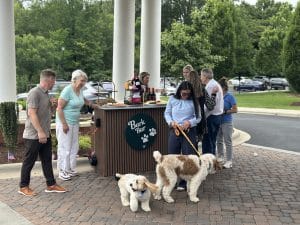 As part of its efforts, Waltonwood has introduced the “Bark Bar,” a handcrafted, mobile doggie treat station created by Matthew Swaney, a marketing manager for Waltonwood. Swaney’s dog, Sheldon, serves as the bar’s “Barktender,” greeting guests and handing out dog treats during pop-up events that serve as donation drives for local animal shelters.
“The Bark Bar has been just pure joy,” Bailey said. “It’s been a lot of fun, and it’s helped drive in so many donations.”
Bailey said Waltonwood learned through its efforts that there are seniors who do not want to take a pet for the long term but who are able to foster one temporarily. Waltonwood consequently has created a foster program in partnership with the Humane Society.
“It’s great for the people, and it’s great for the pets,” Bailey said.
Bailey said other senior living communities interested in partnering with local animal rescues and shelters should not hesitate – “Identify a partner, pick up the phone and get to work.”
“Just ask how you can help,” she said. “It’s relatively easy to get your program off the ground. It’s just finding somebody that needs the help, and I think every rescue or shelter needs help right now. All the shelters are overloaded, so just pick up the phone and extend that first olive branch and ask ‘what can we do to help?’”