
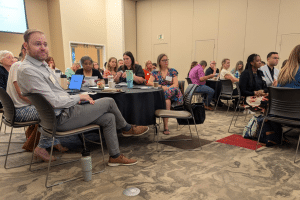
 On August 18, Argentum and the North Carolina Assisted Living Association (NCALA) hosted the Senior Living Workforce Symposium at Guilford Technical Community College in Greensboro, NC. The one-day event brought together leaders and practitioners from North Carolina, Virginia, South Carolina, and Tennessee to explore the challenges and opportunities shaping the assisted living workforce—and to highlight promising pathways forward.
The symposium was filled with candid conversations, personal testimonials, and practical strategies. Conversations moved seamlessly between policy updates, personal narratives, and actionable strategies, reflecting the complexity of today’s workforce challenges. Attendees left with not only new insights but also a renewed sense of urgency, and optimism, for shaping a sustainable future for the senior living workforce.
Shifting Policy Landscape: Medicaid Funding in Focus
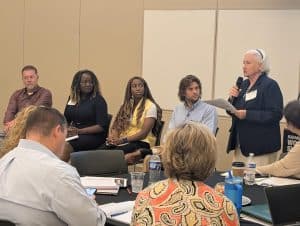 One of the most pressing issues raised during the symposium came from Frances Messer, President of NCALA, who shared breaking news about recent decreases in Medicaid funding across the state. Messer emphasized that the reversal in funding puts those gains at risk, creating uncertainty for providers who were just beginning to see momentum in recruitment and retention. The announcement prompted discussion about the need for adaptive workforce strategies, from leveraging partnerships with immigrant and refugee organizations to maximizing apprenticeship and grant opportunities.
By sharing the NC Newsline article “Medicaid rate cuts will cost state providers $1.1 billion, NCDHHS says”, Messer reinforced the urgency for senior living and assisted living leaders to remain vigilant and proactive. For many attendees, the takeaway was clear: policy shifts can change the playing field overnight, making advocacy, collaboration, and diversification of workforce pipelines more critical than ever.
The Power of Career Pathways for Immigrants
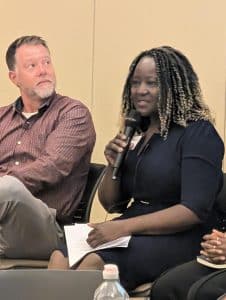 Another standout theme of the day was the role that immigrant and refugee populations play in sustaining and strengthening the senior living workforce. NCALA shared several success stories from individuals who arrived in the U.S. seeking opportunity and found both stability and purpose in senior living. Their testimonials spoke not just to personal triumph but also to the broader value of creating intentional career pathways that support advancement from entry-level caregiving roles into supervisory and leadership positions.
One of the most moving examples came from Beatrice Oywer, Sunrise Senior Living. Oywer recounted her journey from West Africa and her early years in the U.S. as a frontline caregiver. Through persistence, education, and mentorship, she rose through the ranks to lead multiple Sunrise communities across state lines. Her story underscored how senior living can be a launchpad for long-term careers, offering opportunities to those who may have initially faced barriers to employment.
Speakers and attendees alike noted that these success stories highlight the importance of investing in immigrant workforce pipelines. Career pathways, they agreed, are not only essential to recruitment and retention but also to building an industry culture that values diversity, equity, and belonging.
National Perspectives and Apprenticeship Opportunities
The symposium also provided a platform to connect state-level challenges with national workforce strategies. Argentum staff emphasized that while local solutions are critical, the senior living workforce crisis is a national issue requiring coordinated approaches. Apprenticeships emerged as a particularly promising model—one that blends education, training, and on-the-job experience into structured career ladders.
During the session, Argentum presented examples of how apprenticeship programs have been scaled across states to provide clear entry points for new workers while also helping employers address high turnover. Apprenticeships, they noted, not only bring consistency to training but also signal to prospective employees that senior living is a field worth investing in long-term.
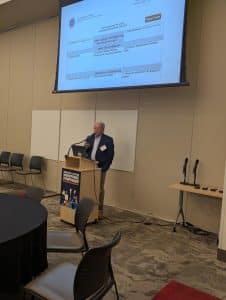 Dan Passarella, Direct Workforce Services Liaison with Argentum, delivered a detailed briefing on how providers can tap into existing funding streams to support apprenticeships and recruitment. He outlined federal and state-level grant programs, as well as resources available to operators who partner with immigrant and refugee organizations. His presentation offered practical takeaways, highlighting that with the right approach, employers can leverage outside funding to offset training costs, making apprenticeships a sustainable part of their workforce development strategy.
The session concluded with a panel discussion where leaders shared their perspectives on college programs and apprenticeships as a tool for retention and career growth, not just recruitment. Panelists agreed that community colleges perform a vital role in Care Giver training and career preparation for Senior Living.
Building Bridges: State, Education, and Refugee Services
Several presentations underscored that solving workforce shortages requires collaboration across government, education, and industry stakeholders. The North Carolina Department of Health and Human Services (DHHS) provided an overview of the immigrant-to-employment process, noting that while legal immigration numbers have declined in recent months, the need for immigrant workers in senior living continues to grow. This underscored the importance of tapping into available state resources to connect qualified individuals with career opportunities.
Hayden Swanson from DHHS expanded on this by outlining the state’s robust refugee service infrastructure. North Carolina’s model integrates refugee support across government agencies, educational institutions, and workforce development providers—offering a comprehensive system for helping newcomers transition into the labor market. Argentum’s Foreign-Born Workers Guide was also highlighted as a tool operators can use to better understand and engage with these populations.
Education partners are also stepping up. Warren Crow, from Guilford Technical Community College’s Health Education Department, shared his experiences engaging students around careers in senior living. He emphasized that students respond most strongly when they see caregiving not just as a job, but as a form of social good. He encouraged providers to incorporate messaging about the meaningful impact of working with seniors into their outreach.
Finally, Andy McCracken provided updates on the newly established NC Center on the Workforce for Health, which he directs. The Center is a hub for developing and deploying statewide workforce strategies, particularly around nursing, direct care, and behavioral health. Affiliated with the University of North Carolina, the Center is designed to withstand political transitions and sustain long-term workforce planning, ensuring that health and senior living providers can continue to access coordinated strategies and support.
Together, these initiatives paint a picture of a state moving toward a cohesive, system-wide approach to workforce development, with immigrant support, education pipelines, and policy frameworks all playing a role.
Closing with Urgency: Addressing Workforce Shortages
The day concluded with a data-driven yet deeply personal presentation from Charles Turner, CEO of KARE, who pulled together the themes of the symposium and grounded them in workforce realities. Turner shared statistics showing that North Carolina’s senior living workforce shortages are currently more severe than those of its neighboring states—a troubling trend with far-reaching implications.
He highlighted how demographic pressures, wage competition with other industries, and the declining pipeline of new entrants into caregiving roles are converging to create a perfect storm. Without bold action, Turner warned, the gap between workforce supply and resident demand will continue to widen, threatening the ability of providers to deliver quality care.
Yet Turner also struck a note of determination. He emphasized that while the shortage is daunting, it is not insurmountable. By investing in apprenticeships, embracing immigrant and refugee pathways, and leveraging technology to ease staffing challenges, senior living can begin to bend the curve. His message reinforced what had been evident throughout the day: solving workforce shortages will require urgency, creativity, and collaboration.
Looking Ahead
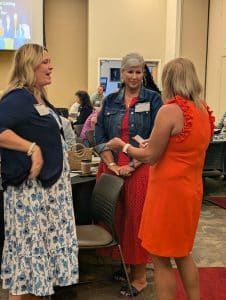 The Senior Living Workforce Symposium in Greensboro was more than a one-day conversation; it set the stage for sustained collaboration. The energy in the room reflected a call to action of urgency, creativity, and collaboration. Attendees left with a clear sense that the workforce crisis is not a distant challenge but a pressing issue demanding immediate solutions.
The Symposium underscored just how urgent and complex workforce challenges have become, and it also proved the power of collaboration and innovation. These conversations will continue on an even larger stage at the Senior Living Leadership Summit, taking place November 17–19, 2025, in Scottsdale, Arizona.
One featured session, “Outsider Insights: What Senior Living Can Learn from Workforce Innovations in Other Sectors,” will push the dialogue further by looking beyond the boundaries of senior living. Industries such as hospitality, healthcare, and food service have long confronted the same staffing and retention challenges now pressing on senior living. During this session, leaders from these industries will share how they’ve built stronger recruitment pipelines, created clear career pathways, and deployed technology-enabled staffing models to better manage demand.
For senior living executives, the value lies in translating those lessons into their own operations. The discussion will encourage attendees to think outside the sector, drawing inspiration from proven workforce solutions that can be adapted to meet the unique needs of senior living. Whether it’s exploring how restaurants have developed fast-track training programs, how hospitals have structured career ladders to reduce turnover, or how hospitality has leveraged flexible scheduling, the goal is the same: to spark fresh ideas that can attract, retain, and empower a resilient workforce.
Registration for the Senior Living Leadership Summit is open. Be sure to secure your spot before September 22 to take advantage of early bird savings and join industry leaders in Scottsdale for this essential conversation. As the workforce crisis continues to evolve, the Leadership Summit will be a vital opportunity to gather insights, share strategies, and take action. The Workforce Symposium may have been a one-day spark, but Scottsdale promises to be the next big step in shaping the future of the senior living workforce.